


Last weekend, I stood on my friend’s land on Gabriola Island, reaching through branches, picking sun-warmed berries right off the bush. I was so craving this; about half those berries didn’t make it to the bowl.
I had just finished writing the chapter on Rooted Nourishment for my Pink Zones book, and loved that the idea was no longer on the page— it was in my body, and all around me.


I had come to Gabriola for a Bhakti festival, to tone my throat chakra singing Kirtan, and spend time with my soulful friend Janie. Gabriola is one of British Columbia’s Gulf Islands — one of those magical places many of you, my readers, already know –-places some of you live on or are very acquainted with, places that exist slightly outside what we would call “ordinary life”. This island is home to artists, gardeners, makers, musicians, healers, sailors, carpenters, craftsfolk, and people who have chosen to live a little differently: sometimes more simply, sometimes partly off-grid, often keeping it weird (like Portland) and always creatively.
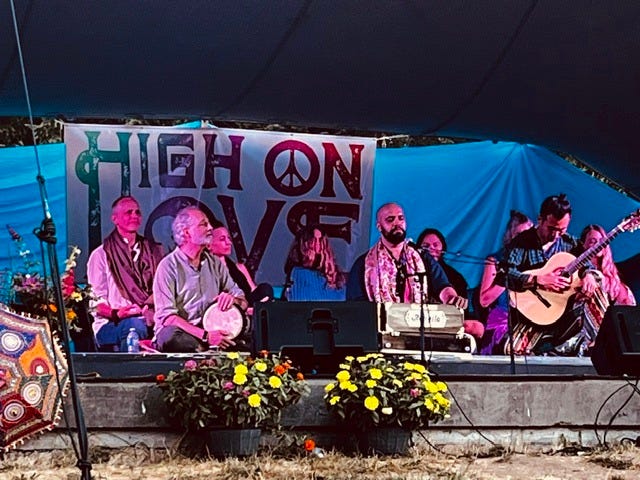
Gabriola is chock full of Pink Zones women.
Janie Ringham is always trying to persuade me to move there, and I understand why. I am in bliss when I visit this dear friend anywhere adventures find us, but especially when I get to glamp on Gabriola! I have spent other chapters of my life closer to the land. Twenty-five years ago, I lived off-grid on a quarter section on the side of a mountain, in a cob house I helped build with my first husband in beautiful Golden, BC — a small mountain town with a really gold community. We built a cob sauna cabin and carved a pond into the earth, fed by a cold spring, for cold plunges. Now I pay $49 plus tax for 110 minutes of the same thing, in the hip spas and Zen Den sanctuaries that have sprouted up around the city. I go to Wreck Beach (UBC’s only nude beach) as much as I can. I do genuinely enjoy having fewer layers between myself and the natural world.


I have also had the fortune to live in places with big gardens and known the deep satisfaction of planning dinner around whatever was ready to be plucked. So, of course, there is still a part of me that longs for that version of life: less traffic and stimulation, more room to notice what is growing, outside and inside.
Food has always been one of the ways I notice and nourish. I have worked as a chef, in one form or another, for much of my life — through university, in backcountry lodges and retreat centres, teaching cooking classes and cooking for the people I love. I have been studying nutrition for thirty-five years, first through food and kitchens, later through naturopathic medicine.
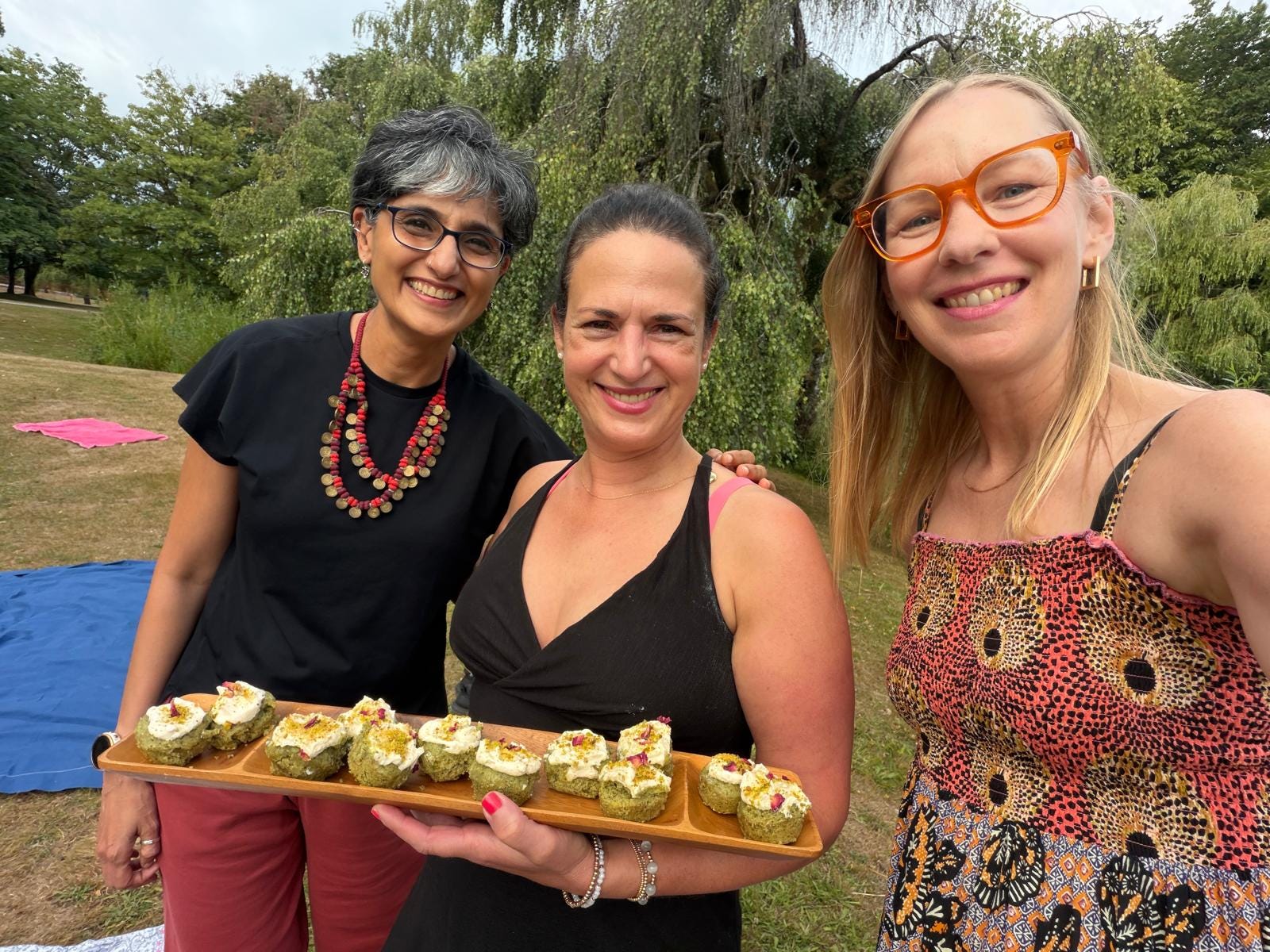
I don’t often think of myself as an artist, but I can accept the word when it comes to cooking. Cooking has always come naturally to me since I started as a teen. I love that it is both useful and sensual. (I’m a Capricorn!) I’m drawn to the alchemy of turning ordinary individual constituents into something more beautiful as a delicious whole dish. I am the kind of person who will make vegan, gluten-free pistachio cupcakes with rose and cardamom — not because anyone needs a nutritionally optimized cupcake, but because these flavours make me happy (the cardamom, especially (fresh from India, gifted from my friend, Sukhpreet MD | MenopauseWize shown here with our fellow lit up Bonfire builder Rosalee.
This matters, because nourishment is so often reduced to the least interesting part of food — its individual constituents.
Protein. Fibre. Iron. Magnesium. . Enough — but not too much — carbohydrate. A perfect distribution of macronutrients.
I understand the importance of all of it. It matters clinically. A woman needs sufficient protein to preserve muscle. She needs iron, B vitamins, essential fats, and minerals. She needs healthy food to support her brain, her hormones, her immune system, her bones. But a woman can be consuming all the right nutrients and still be deeply underfed. She can have the protein target, the leafy greens, the supplements, and the carefully constructed meal plan. She can know her ferritin (storage form of iron), her fasting glucose and insulin. She can eat every food that is supposed to support longevity and still be hungry for beauty, rest, pleasure, touch, purpose, belonging, or care.

Nutrition and nourishment are not the same thing.
This gap is not abstract, and it does not spare midlife. We tend to imagine disordered eating as a young woman’s struggle, but it can persist, recur, or first appear decades later. Research done in 2023 suggested that about 3.5% of women over forty meet criteria for an eating disorder, while particular eating-disorder symptoms may occur in as many as 29.3%.(1) Behind those numbers are women who know exactly “what” they should eat — and are in a tug of war with food anyway.
This is not simply a failure of willpower. Under sustained strain, appetite can change in either direction. (2) For some women, stress heightens the pull of sweet, rich, calorie-dense food but because stress hormones, sleep, reward pathways and appetite signals are all involved in how and what we want to eat. (3)
Appetite is not governed by discipline alone. It is shaped by whether we are adequately fed, rested, supported and able to feel at home in our bodies. Which means that, for many women, the more honest question may not be, How do I control this hunger? but, What am I actually hungry for?
Rooted Nourishment isn’t about rejecting nutritional science. It’s more about expanding what we allow nourishment to mean. It asks us to consider food not only as chemistry, but as memory, medicine, culture, lineage, rituals and love. It asks whether our meals connect us to our bodies or make us more stressed about them. Whether food is shared or eaten hurriedly over a screen. Whether we have the capacity to digest — not only what we eat, but the lives we are living.
And it asks what else must be present for us to feel truly fed.
As appealing as Gabriola is, Vancouver holds forms of nourishment I would not want to leave behind: friendships, work I care about, the ocean and the mountains, and a community I am helping to build.

Bonfire Gathering on the Beach
A few days after this trip, we held our third in-person Bonfire group at the edge of Jericho Beach. We were tucked into a small, protected nook beneath the trees, close enough to smell the ocean
but sheltered from the rowdy activity of the beach. The theme was Rooted Nourishment.
Neuroscience educator Sarah Peyton describes the many streams through which nourishment enters a life. Food is one stream. But it is not the only one.
We are also nourished by deeply breathing clean air (forest-fire-free!). By delight and play. By rest. By meaningful work, creativity, movement. By resonance and belonging. By the feeling that someone else is beside us — paying attention, sharing the weight, helping to protect and hold what we are trying to create.
That evening, many of these streams came alive. I had asked one of my newer friends to join me in facilitating. Krista Tricarico is also a naturopathic doctor who went to the same medical school I did in Portland, OR. What I so appreciate about Krista is that they don’t just teach mindfulness; they embody it — grounded, warm, and present, yet curious and open. A Vipassana meditator, their clinical work focuses on the nervous system and mental health. To begin, Krista guided us through a lovely settling-in meditation and then into a step-in circle — a practice in which people step toward the centre when a prompt resonates, a way of seeing who is in the room and what we share or don’t: who here likes sitting on the grass better than a chair? Who here has been divorced? Where here has a dog as big as a pony? That kind of thing.


It turned out to be so meant to be that I was not the only person holding the circle. One participant was having trouble finding us tucked into the forest next to the beach. Although I had described and pinned our location on the east side of the park, she had ended up on the very west side; my phone kept pinging, and I had to leave the circle several times to guide her toward us.
There was something almost comically perfect about being repeatedly called out of the calling-in circle.
But it revealed something too. Because Krista was there, the circle continued. The gathering did not unravel when I stepped away. I did not have to be the only leader, the only guide, the only person responsible for holding everything together.
Two Pink Zones pillars became real at once. Rooted Nourishment was there in the trees, the salt air, the grass beneath us, and the sweets we shared. Community and Connection were there in Krista’s presence amongst all the others— in the simple, profound relief of having another person who could hold the circle when I could not.
Perhaps this is what nourishment looks like. Not a perfectly balanced plate assembled by one increasingly overwhelmed person. Not another list of nutrients to consume, habits to master, or wellness practices to perform correctly. Not the fantasy that if I could only become informed enough, chill enough or efficient enough, I could meet every one of my own needs alone.
Nourishment is also the land beneath us, the people around us, and the relief of discovering that we do not have to hold the entire circle by ourselves.

Perhaps nourishment reaches us through more streams than we realize:
air, water, food, rest, nature, touch, intimacy, creativity, meaningful work, resonance, delight and play.
Which of these do you receive with ease?
And which one do you notice you are craving —is there one calling you now?

References:
Finch JE, Xu Z, Girdler SS, Baker JH. Network analysis of eating disorder symptoms in women in perimenopause and early postmenopause. Menopause. 2023;30(3):275–282. doi:10.1097/GME.0000000000002141.
Epel E, Lapidus R, McEwen B, Brownell K. Stress may add bite to appetite in women: a laboratory study of stress-induced cortisol and eating behavior. Psychoneuroendocrinology. 2001;26(1):37–49. doi:10.1016/S0306-4530(00)00035-4.
Dallman MF, Pecoraro NC, La Fleur SE. Chronic stress and comfort foods: self-medication and abdominal obesity. Brain Behav Immun. 2005;19(4):275–280. doi:10.1016/j.bbi.2004.11.004.
What a beautiful and extraordinary experience, Heidi! I do love my vicarious vacations and this one was a delicious delight - on so many levels. I keep going back to those sun-warmed berries you ate from their bushes. Sometimes it’s the most simple things that nourish us most. 💕
I so love hearing about all your adventures and all the beautiful community you bring into the world. I rarely think about food very deeply because I don't cook. I wish I did, but it's something I never really learned and I feel like I never have time. It's not that I don't appreciate the many-layered goodness of truly nourishing food (both in terms of nutrients and the experience of preparing, consuming, and sharing), but most of my eating is designed around convenience, ease, and speed. Reading this makes me feel like I should rethink it.
As for the other kinds of nourishment ... we all need MORE of those! Too many days pass with hardly any soul nourishment ... or only the barest morsel that we have snatched out of the hustle and bustle of the day. We deserve more.