



When Fox News starts giving a group of women a nickname, it’s rarely flattering — but it is revealing.
Recently, conservative commentators began using the term “Chardonnay Antifa” and “Wine Moms” to describe the older, affluent women protesting ICE. The phrase is meant to trivialize them, paint them as unserious.
But nicknames are never entirely neutral. Historically, groups are named when they stop being ignorable. For decades, midlife and older women barely registered in political or cultural imagination at all. Now they’re visible enough to be mocked, and have their political bona fides debated on prime-time TV.
That visibility didn’t emerge overnight. It reflects a deeper shift that has been quietly unfolding in our culture over the last decade or so, one rooted in how women experience midlife itself, and how that experience is now intersecting with a rapidly changing world.
As a doctor with more than 20 years of experience working with women in midlife, I see menopause as more than a health transition. It’s a political, economic, and cultural inflection point — one that exposes how our systems respond when women’s lives change. Now we’re seeing how women respond when systems change.
Women in this time of life are seeking more than relief from symptoms (though that matters, too). They’re seeking rights, respect, and recognition — in healthcare, in workplaces, and in the stories we tell about aging. As Soraya Chemaly, director of the Women’s Media Center Speech Project and author of All We Want Is Everything, has argued, women today aren’t asking for special treatment, but for the ability to live with dignity, agency, and authority within structures that were never designed for them.
So why is this happening now?

Internal authority becomes external voice
As I wrote in my previous essay about what a Kamala Harris presidency could signal for women and aging, midlife brings a profound internal shift, one in which authority moves inward. Women waste less energy trying to shape themselves to meet expectations and more energy on becoming the women they actually needed to see. Many call it “having fewer f’s to give.” I call it advancing into power.
What’s different now is that this inner clarity is turning into an outward voice. Still, culture has not caught up. According to the Geena Davis Institute’s 2024 “Frail, Frumpy & Forgotten” report, women over 50 in films are much more likely than men to be shown as senile, weak, or frumpy. Only one in four films passes the Ageless Test, meaning an older woman is shown as important to the story, not just a stereotype.
That long history of erasure helps explain why this moment feels charged. Midlife women are no longer willing to be invisible — culturally or civically. They’re asserting their voice and presence in spaces that once sidelined them.
In terms of the menopause transition, what was once managed privately is now being named publicly. Social media has accelerated this shift. Experiences that once lived in isolation — confusion, rage, insomnia, and a myriad of physical symptoms — moved into shared digital spaces. For many women, the moment of asking themselves Am I losing it? was met not with dismissal, but with recognition. That validation reduced isolation. It normalized experience. It cracked open the silence.
That shift matters. Validation alone isn’t a solution — but it is often the first step toward agency.
Women are now asking questions that were once left unspoken: Why are medical systems so often unprepared for — or dismissive of — women in midlife? Why does research lag so far behind prevalence and impact? Why is public funding insufficient for conditions that affect half the population?
These questions are no longer whispered. They’re being voiced: in living rooms, online communities, public forums, and increasingly, in publications like this one.

The world is changing, and women feel it
This awakening is unfolding against a backdrop of national instability. Rights we once assumed are being rolled back. Political decisions that shape women’s lives are often made without women at the table. For many, silence no longer feels like a survival tactic; it feels like complicity.
Women who once would’ve kept their concerns private are now speaking publicly, because the stakes feel shared: from reproductive rights and maternal mortality to research gaps, workplace protections, and access to care. Menopause is one point in a longer continuum of women’s health issues being under-recognized and under-funded.
Halle Berry’s recent comments calling out California Governor Gavin Newsom for overlooking women in midlife weren’t just celebrity remarks. They signalled a turning point in how menopause and midlife are being discussed — not as personal-wellness issues, but as civic ones. Berry wasn’t speaking only about symptoms or treatments; she was giving voice to a constituency that has long felt unseen by the very leaders who rely on them.
As Shannon Watts, founder of Moms Demand Action and author of Fired Up, told me: “Gen X women, 40 million of whom are now well into their forties and above, hold over $15 trillion in purchasing power. We are the wealthiest, healthiest, and most active generation in history, and by 2025, it’s estimated that 1.1 billion of us will be post-menopausal. It’s time we band together to demand the care we need and deserve to live full, active, and healthy lives.”

Visible, finally
This convergence –of women’s lived experience, economic power, and political awareness -is now showing up in public life in unmistakable ways.
In recent weeks, tens of thousands of Americans have taken to the streets to protest aggressive immigration enforcement following the fatal shooting of Renee Nicole Good, a Minneapolis woman killed during a federal ICE operation. Large marches and rallies in cities like Minneapolis and St. Paul have drawn national attention. Photos show crowds holding signs, chanting, and standing shoulder to shoulder– including many midlife and older women.
In some cases, these women have been among those arrested, or directly confronting law enforcement. These images are a reminder that this participation is not symbolic, but embodied and consequential.
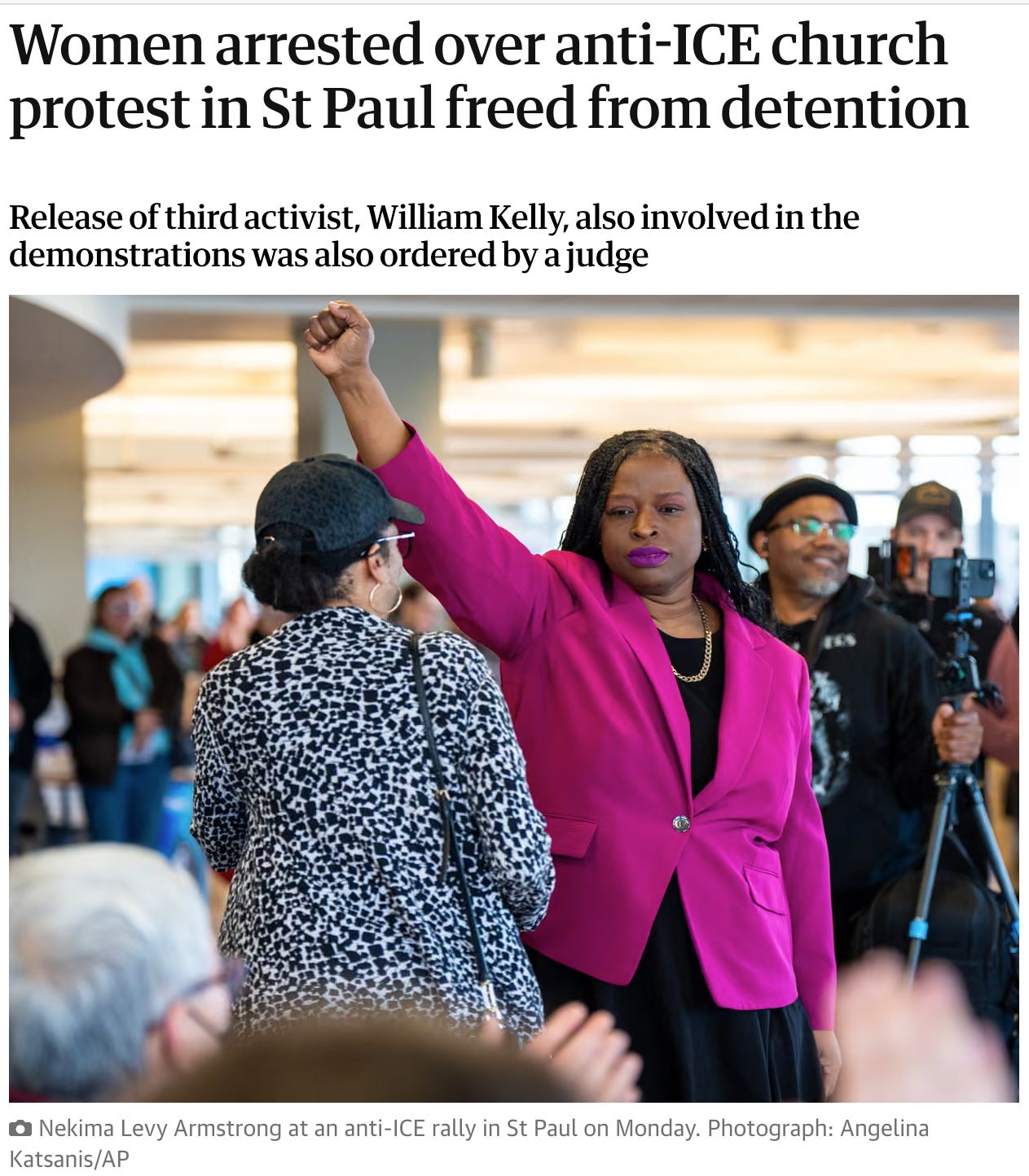
This pattern extends beyond immigration protests. As reported by The 19th News, sociologist Dana Fischer researched the June 14th No Kings Day of Action – part of a broader pro-democracy movement and found that the majority of hosts and participants were female, predominantly white, and highly educated. This echoes patterns seen during resistance movements in the Trump administration’s first term and underscores the fact that midlife and older women are often organizing from the front, not the sidelines.
The women being labelled as “wine moms” aren’t protesting only for themselves. Many are standing up for migrants, for children, and for communities they may never personally belong to. Women in midlife and menopause are capitalizing on a life phase when the pressure to please recedes, clarity sharpens, and concern for the collective deepens.
When Fox News calls these women “Chardonnay Antifa,” it attempts to flatten them into a caricature. But that dismissive trope obscures the reality: Midlife women are increasingly present, organized, and unafraid. They’re caregivers, voters, and community stabilizers. They make up a substantial portion of the workforce and contribute billions of hours of unpaid labour each year. And they vote — at high rates. Women aged 50 and older made up nearly 27% of all registered voters in 2020 and cast 30% of all ballots, with turnout as high as 83%—higher than the overall population.

MontrealSouvenier.ca -available for purchase, (Heated Rivalry fan —or non)
The Quebec motto (and licence plate) “Je me souviens” — we do remember — seems apt here. (Regardless of the occasional perimenopausal memory lapse, as our brains rewire.) Ignoring this group is no longer a neutral political strategy; it’s a risky one.
The political awakening of midlife women is not a fleeting phenomenon — it marks a civic shift.
What this shift looks like in real life is quieter than we expect.

Now I want to talk about someone I know.


Jamie Wallace is a midlife woman who has shown up — every week for the past year — to protest in her small town in Massachusetts. Not for followers or chardonnay. Simply because she believes it matters.
She is not a public figure, not a celebrity, and not anything close to the caricature of a “wine mom.”
I met her through a writers’ group on Substack. SuddenlyJamie is an exceptional writer with a keen, creative eye, and her work has real moxie — even on Mondays. There is insight and courage in her newsletter, Inner Wilderness Unlimited, the same quality that shows up in her actual life.
Jamie also organizes a bi-weekly Zoom group we’ve come to call Substack Sirens — writers who gather to talk, commiserate, and laugh. We cheer her on as she leaves to bundle up and head out to protest just as our Zoom group wraps up. Most of us aren’t out there in the cold the way she is. But we benefit from her steadiness. We are buoyed by it, and by her.
Jamie doesn’t look like a movement. She isn’t branded. But she is committed. She is informed. She is paying attention to people beyond herself — and acting on it.
This is the version of influence that rarely gets named. It’s steady. It’s not glamorous. And it’s exactly what makes real change possible.
If this is the definition of a wine mom, I’d better start training.
What we’re seeing now isn’t a theoretical shift or a caricature. It’s lived.
The world is catching up to the fact that midlife women are a power base. What’s rising now isn’t just a wine glass: it’s presence. And it’s no longer possible to ignore.

If this article resonates, this is the kind of conversation that lives beyond the page inside The Pink Zones Podcast Club. ….like a book club- only podcasts!
If you’re looking for a place to gather in community, you’re welcome to join us.
Our first one of 2026 is Feb 19th! Sign up here!


If you’re enjoying being part of my beginning journey here— and, if you’re reading this, you are already a part of this adventure — I’d love for you to leave a comment, or share this post.
And if you’re reading this in email, please always feel free to hit reply and send me a private message that way. I’d love to hear from you!
Well, now I do feel a little famous. 😉
Thank you for delving into this trend and giving us some important context. There is a lot of power in deciding you’re not going to be invisible anymore. I am inspired each and every week by all the women who are older than me and still show up every damn week. They are not afraid and they are not backing down. I’m grateful to have their example as inspiration.
An excellent piece, Dr. Heidi, on so many fronts! xx