


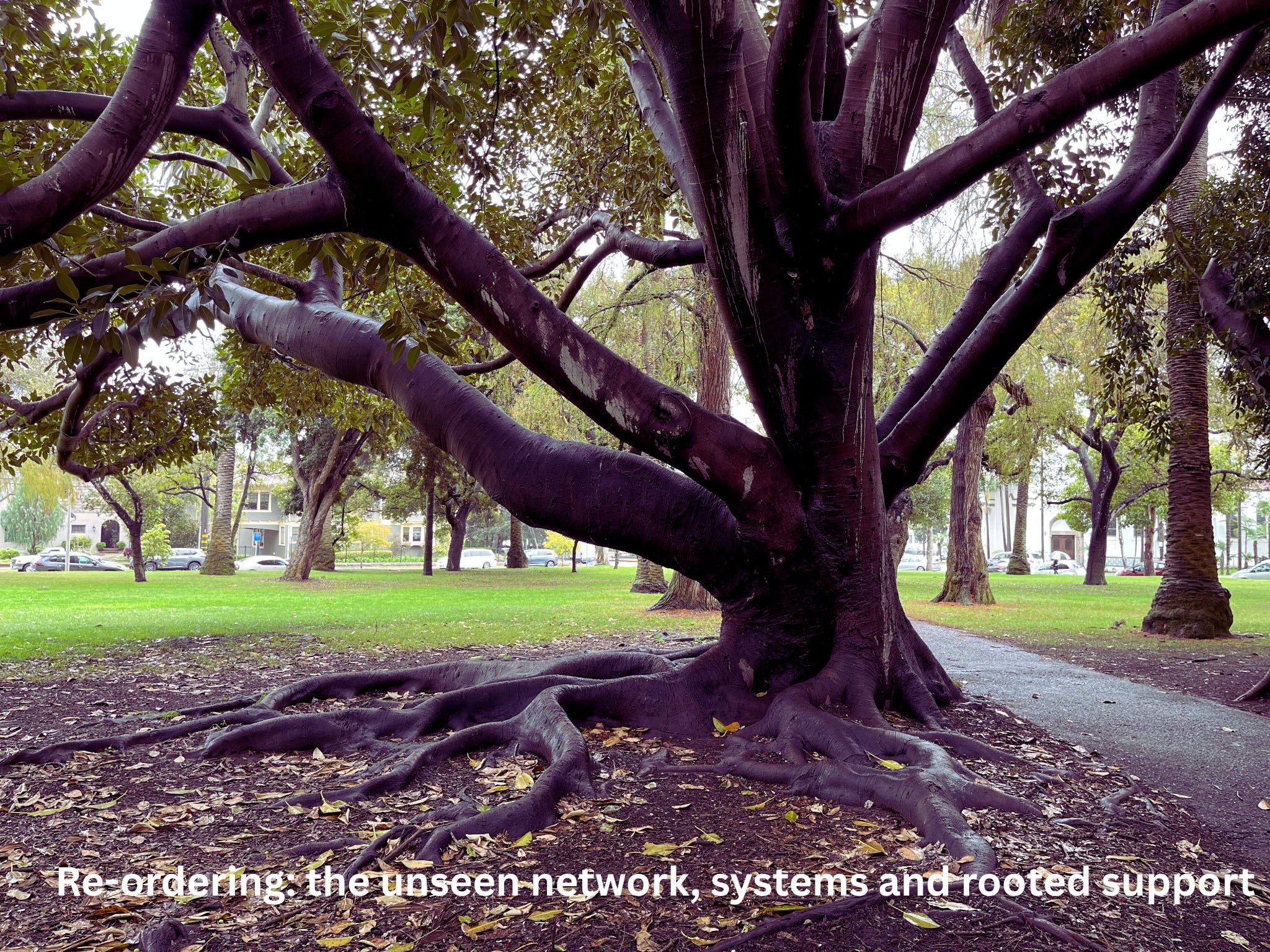
Growing up has a way of breaking spells. And right now, the wellness hero spell is breaking too.
Many a famous figure has fallen—among them a prominent wellness hero whose reach exceeded his integrity.
There’s a dark underbelly being revealed by the Epstein files: patriarchy, power, and the way an authoritative style—positions, credentials and confidence—can be mistaken for integrity. But my wheelhouse is health. So that’s where I want to look: what this moment reveals about medicine, wellness culture, and what we are longing for when we hand someone so much authority in the first place.

The hero model of health is starting to crack.
For years we’ve been living inside a heroic story—first medicine-as-hero (the doctor, the drug, the procedure), and then a newer version: the optimization hero. Confident. Data-driven. Certain. He promises something seductive: control over aging, over uncertainty, over the messy ambiguity of being human. Track enough, supplement enough, follow the protocol closely enough, and you can outsmart your biology.
For a while, it felt reassuring.
Lately, though, the hero narrative is wobbling—not only because prominent figures fall from grace, but because more of us are waking up to a harder truth: there’s a cost to outsourcing our sovereignty. We’ve handed authority to individuals whose influence can outpace their accountability. But also when the institutions meant to keep us well—medicine, public health, and now wellness culture and AI—feel disconnected from lived human experience, trust doesn’t just erode. It unravels.
If you want to see where this crisis of authority shows up most clearly, start with perimenopause—then follow the thread into a woman’s decades beyond.
Menopause isn’t only a physiological transition. It is often a psychological and civic awakening—an accelerant that makes it harder to tolerate dismissal, perform “fine,” or keep self-abandoning.
As women age, bodies shift, sleep shifts, brains re-wire and along with these changes come a growing unwillingness to remain silent and accept the status quo. These transformations not only shape daily life, but also fuel a renewed determination to question and challenge what is no longer serving them or others they care about. Women want more than just relief from symptoms, though that certainly matters. They seek rights, respect, and recognition in policies, workplaces, and public stories.
That may be why midlife women have recently become a cultural focus. In a recent piece I wrote for Katie Couric Media, I looked at how the label “wine moms” is being used by right-wing media not to describe drinking, but to diminish and discredit midlife and older women who have been involved in recent protests. The insult is telling: it suggests these women have become newly visible, highly organized, and therefore newly threatening to the status quo—powerful enough to require caricature.
What’s cracking open is larger than any one person, or stereotype; it is a culture facing the limits of hero narratives and searching for what comes next.

The rupture underneath the rupture:
What we’re watching in wellness is not simply a scandal cycle. It’s a transition. When a public hero cracks, we’re forced to admit what we were hoping he could do for us: simplify complexity, solve what our systems can’t. The good news is a rupture of trust can become a waking up and turning point.
Order - Disorder - Reorder
Medicine has gone through this arc before. Much of the 20th century was an era of medical confidence—an “order” phase—when antibiotics, vaccines, and surgical breakthroughs created a sense of mastery over disease. Doctors became cultural heroes; and interventions became synonymous with healthcare.
Then came disorder: chronic illness, burnout, escalating costs, fragmented systems, and the unsettling experience so many patients know: being reduced to a symptom, a lab value, a billing code. The old order no longer holds. Yet the new one isn’t fully formed.
In that uncertainty, people reach for substitutes. “Dr. Google,” influencers, and a new class of wellness authorities who speak with certainty because certainty sells. But the deeper hunger isn’t for a stronger hero. It’s for a model of health that can hold complexity without turning people into machines.
Women in midlife are often the first to recognize this, because they’ve been living the mismatch for years. Perimenopause arrives with real physiological upheaval—sleep disruption, anxiety, brain fog, shifts in mood and metabolism—and too often the response from the system is a shrug: stress, aging, “it’s normal.”
When women are dismissed at the very moment their lives demand steadier support, they don’t just lose trust in a clinician. They lose trust in a story: that authority will automatically be wise, and that health is something you can control if you try hard enough.
Evidence-based medicine is the gold standard—when the evidence exists. But in women’s health, especially beyond fertility, conception and childbearing, the evidence is often startlingly thin. Menopause sits within a broader pattern of neglect: historically, women’s health has been underrecognized and underfunded by major research institutions. A National Academies report noted that from 2013 to 2023, women’s health research accounted for about 8.8% of NIH research grant spending, leaving female-specific life stages—including menopause—underprioritized.
Women are also still underrepresented in many clinical trials.
When women’s bodies are left out of research, entire stages of life are misunderstood, treated unevenly, and lack resources—and what women experience as a personal health failing is often the downstream effect of structural omission. I see this every day in my practice: what feels like an individual problem—”I’m doing it wrong”—is often a predictable result of larger neglect.

The trap of optimization
This is where the wellness hero narrative becomes especially dangerous. It trains people to interpret disorder as personal failure: if you’re not sleeping, not thriving, not aging “well,” then you must not be disciplined enough, optimized enough, calm enough.
For women in midlife, that message lands on top of an invisible pile I think of as the longevity load—the cumulative weight of stress, sleep debt, hurried nourishment, sedentary living, chronic inflammation, environmental exposures, unresolved grief, and the erosion that comes from disconnection: from community, from meaning, from the body’s signals.
Perimenopause doesn’t always create that load. Often it reveals it. It exposes what we have been carrying—and what our culture has been asking women to carry quietly for decades.
This is also why the hero story fails women so predictably. The dominant wellness narrative is built on individual mastery: find the problem, hack the body, optimize the machine. It is clean, linear, and often male-coded. But women’s health—especially in midlife—is not a machine problem that can be overridden into compliance.
Midlife is not a productivity puzzle. Menopause is not a failure. Aging is not a glitch.
And yet optimization culture keeps telling us that the right tracker, supplement stack, protocol, or discipline is the solution. It can turn health into a panopticon of self-surveillance, one more arena where women feel behind, overwhelmed, and alone.

Reorder
If there is an alternative, it begins with a refusal— and a resistance: refusing to treat disorder as the end of the story.
Order, disorder, reorder is a helpful map many people recognize intuitively—one articulated well by Father Richard Rohr, who describes the passage from certainty, through disruption, toward deeper integration.
In medicine, reorder doesn’t mean rejecting science. It doesn’t mean romanticizing “natural” over “modern.” I wrote about this last year, it means using what works while outgrowing what doesn’t. It means care that is relational rather than transactional, preventative rather than perpetually reactive, and considers the social conditions that shape the body.
In aging, reordering doesn’t mean letting anti-aging culture dictate that we must resist time at all costs. I’m interviewing women and “tracking” the conditions that reliably support thriving in midlife and beyond. I’m using a term for this: ”The Pink Zones”, to describe those conditions. What shows up again and again isn’t a perfect protocol, but a set of pillars: cultural self-worth, belonging, sustainable movement, nourishment, rituals of rest, meaning, and creativity. These aren’t soft extras. They’re load-bearing. (I wrote about the Pink Zones Pillars here)
Menopause can be a body-psyche reckoning: the moment a woman realizes that her second half of life cannot reliably function on first-half of life operating systems. That she cannot keep performing wellness while feeling unwell. That she cannot keep shrinking to keep others comfortable.
In that sense, midlife women are not just canaries in the coal mine. They are early adopters of a new orientation: I will not be managed by dismissal. I will not outsource my knowing.

A different kind of agency
One risk after disillusionment is swinging into hyper-individualism: “Fine. I’ll do it alone.”
We can replace institutions with self-improvement and call it empowerment.
And increasingly, “doing it alone” gets mediated by tech.
We may see through the hero-guru, yet still hand authority to apps, trackers, algorithms, and AI systems, that replicate the same conditions. Used well I bet they can help. These tools process enormous amounts of data and speed everything up. But used as authorities, they harm- especially when algorithms become the arbiter of “normal,” we’re not gaining wisdom—we’re outsourcing it. And we’re choosing to overlook the environmental and human toll of that frictionless quest for our individual health.
But health has never been a solo sport. Neither is cultural change.
The most robust form of agency I see is community-centred. It is people learning together, supporting each other, comparing notes, asking better questions, and insisting that medicine catch up to women’s reality instead of treating menopause onward as a period of inevitable decline. It’s patients who don’t expect magic bullets, and seek a partnership with their clinician, not paternalism. It’s communities that resist guru culture without rejecting expertise. It is discernment practiced together.
The hero-saviour model—medical, cultural, institutional—is losing its grip. That doesn’t mean we’re doomed. It means we’re being asked to grow up.

What comes after the hero
No one is coming to save us. And strangely, that can be good news.
It means we can stop chasing certainty packaged as authority. We can stop confusing confidence with care. We can stop treating the body like a machine that must be dominated into perfection.
Instead, we can build something sturdier: a culture of health that is less heroic and more human, less performative and more truthful—one that understands that health is contextual, and that thriving is not an individual achievement but a collective condition.
The hero story is collapsing. What could replace it isn’t the current chaos, but reordering around a different kind of authority. Authority that is earned rather than branded, relational rather than solitary, embodied rather than optimized.
The future of health doesn’t need another hero. It needs a village.

Sources:
· National Academies of Sciences, Engineering, and Medicine (news release on NIH women’s health research funding; includes 8.8% figure):
https://www.nationalacademies.org/news/to-advance-womens-health-research-nih-should-form-new-institute-and-congress-should-appropriate-new-funding-says-report
· Association of American Medical Colleges (overview of gaps in women’s health research and trial participation; cites 2022 Harvard analysis):
https://www.aamc.org/news/why-we-know-so-little-about-women-s-health
If this article resonates, this is the kind of conversation that lives beyond the page inside The Pink Zones Podcast Club. ….like a book club- only podcasts!
If you’re looking for a place to gather in community, you’re welcome to join us.
Our first one of 2026 is Feb 19th! Sign up here!


If you’re enjoying being part of my beginning journey here— and, if you’re reading this, you are already a part of this adventure — I’d love for you to leave a comment, or share this post.
And if you’re reading this in email, please always feel free to hit reply and send me a private message that way. I’d love to hear from you!
So much to think about here. Thank you for pulling back your lens to take in the bigger picture. While the exposure of these health gurus is a timely and relevant development that is opening our eyes, it’s more important to understand the wider context for what ails us. And you do this so well. It’s both exciting to consider the possibilities, and daunting to comprehend just how enormous the task is. And yet, like most enormous tasks, this one can be approached one small step at a time - changing your personal assumptions, questioning the status quo, advocating for yourself, sharing experiences with other women. Thank you for helping us think through these complex issues.
As I read this Dr. Heidi, Tina Turner's "We Don't Need Another Hero" popped into my head.
I appreciated your sharing of how health and wellness has evolved and the challenges of how women have largely been ignored in the models. I knew the percentage of funds spent on women's health was small and many major studies were not optimized for women, but I didn't realize how much.
I think we always have to be our hero and health advocate and carefully consider the source of information you're using.