


The other day was Mother’s Day, and like most things in life lately, it held more than one thing at once.
My mother is 86. She has dementia, and she lives in a care home in Ontario, while I live in Vancouver — a distance that is geographical and emotional, and sometimes like both at once.
I have written about her before: about the strange tenderness of becoming someone’s guardian when they were once yours; about the grief and grace of that reversal. It has made me think more deeply about what it means to “mother” — especially as someone who never had children of my own.
Doris was a dedicated French teacher, a heart-centred Catholic committed to social justice, and a woman who was often overextended. In taking care of so many others, she frequently abandoned herself in the process. That kind of self-sacrifice was expected of women in her generation. In many ways it still is.
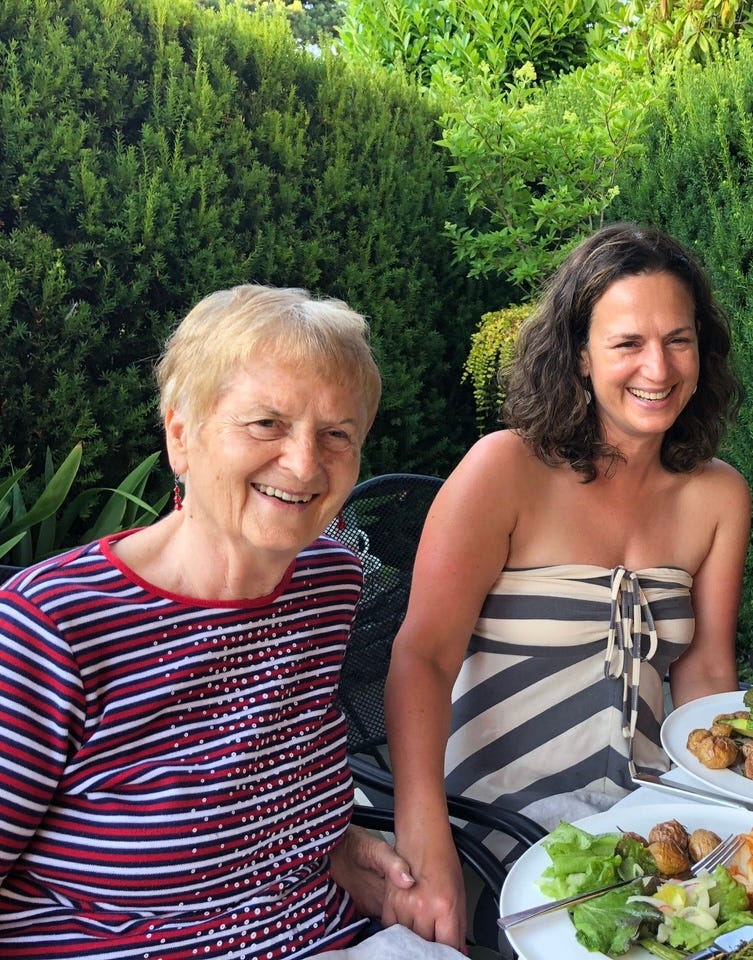
Yesterday I saw something I hadn’t quite seen before in my mum’s face.
I had a FaceTime video with her, and I watched her brain work so hard. She was visibly straining to hold a thread of conversation, to answer a simple question, to stay with me. She rubbed her head. She rubbed her eyes. I do that too when I am exhausted and trying to force myself to solve or complete something on the computer that I so want to be released from.
On my mum though, this tired face-rubbing was constant.
And her face — the one that once animated every room she entered — was blanker than I had ever seen it.
Apathy is common in dementia, not because the person doesn’t care, but because the brain is struggling to generate outward emotional response. In my mum, in that moment, it looked like vacancy. It felt like a strange, potent absence.
This was a woman who was sharp and warm and charming, who made witty remarks and smiled easily, who knew how to be fully present in a room. I am watching that presence recede, slowly, and from very far away.
I didn’t want to dwell there. So I didn’t. I let myself feel it. I cried. Then I moved my body and got outside — a walk in the spring sun, in the forest.
When I came home, I spent much of the day spring cleaning. Not just as a distraction, but as an act of care. There is something deeply satisfying about tending to the chaos that accumulates when life gets too full to manage its shelves and closets. I sorted. I cleared. I made donation piles.
Later in the afternoon, I returned to the trails and biked through the forest to a yoga class. At the end, after savasana, the teacher invited us to turn onto our sides and hug ourselves — saying, “especially if you are mothers.”
I thought: or especially if this day brings up longing for a redo with your own.
Earlier that day, I had spoken with my cousin, a woman who lost her mother when she was a young adult. She never got the full arc of being mothered. That experience was cut short suddenly, and in the most confusing of ways.
And like me, I think she knows the ache of not becoming a mother — not by design, but by circumstance. That distinction matters. There is a different quality to childless grief, a different shape to the longing, when an anticipated path is not actualized, not because you chose not to train for it and walk the journey, but simply because life didn’t arrange itself to open up that particular route to you.
My cousin has done many full marathons around the world. She has built a life of remarkable resilience, soulfulness, and love. She knows how to create warmth and connection. She knows how to love generously, even when life did not make it easy.
After our conversation, I found myself thinking about do-overs.
When I speak with women who became mothers, some describe the experience as having an element of “do-over” for what they missed when they were little ones. Not a blissful, easy thing. Often it is painful, and sometimes marked by overcorrecting — by trying to give your child what you were denied, and feeling both the tenderness and the grief of that at the same time.
But there is something in the act of offering warmth, safety, and nourishment to another person that can begin to repair an original wounding. A way of loving forward what was missing.
I never got that particular do-over with another tiny human.
But I am beginning to understand that I am getting it — slowly, imperfectly, necessarily — with myself.
Not as a sentimental exercise in self-kindness, but as a deeper kind of repair. I’m learning to notice the places where I keep going when I need to stop, over-give when I need to receive, and withhold tenderness from myself in the very moments I most need it.
That is what I mean by remothering.

I also want to offer a small update.
I have been a bit quiet here, and that silence had real reasons. The past year held a great deal: the end of my aunt Kata’s life, inheriting responsibility for my uncle Stjepan (who also has dementia) and everything that came with it, and the accumulated weight of years of caregiving, clinical work, and high output and life never stopping, like it doesn’t for most of us.
I took a sabbatical from my clinical practice.
Some people received this with a warm, “good-for-you “response, “what a wise decision” Others received it with a subtle “must be nice”, as if I were heading off to sip mai tais on a beach somewhere.
It was mostly not a beach holiday. However, I welcome that ahead if you are listening, universe!
Much of it was spent managing the physical and administrative weight in two different locations in Ontario: an estate, a house filled with two lifetimes of belongings, and a care home placement for my uncle. The rest was spent recovering from the kind of depletion that does not fully show itself until you stop moving and realize you have been running on stress hormones for longer than you could safely acknowledge.
I came up close and personal to my own limits with what I have come to call the longevity load — the accumulated weight so many women in midlife carry quietly and largely without recognition: caregiving, invisible labour, emotional responsibility, and the relentless output of holding other people’s lives together while your own begins to fray at the edges.
We are not built to carry this indefinitely without replenishment.
What I learned during this time is one of the oldest truths I know: you cannot lead people where you haven’t been. I needed to go there first.
And I am so happy to share that I now feel much more resourced, human, and like myself.

One of the best things I did during this period was begin a year-long course with Sarah Peyton called Lifting the Shadow off Nourishment: A Year of Healing Mother. The course is rooted in relational neuroscience and understanding how to support our nervous system.
What I appreciate about the course is that it does not treat nourishment as a simple matter of better habits or more discipline. It asks a more complicated, and more honest, question: how is my relationship with myself revealed in the ways I do — and do not — nourish myself? In what I eat. What I reach for when I am depleted. The ways I care, over-care, numb, scroll, strive, or keep going when some part of me is asking to be tended.
And then it widens the lens even further: how was I nourished? How was my mother nourished? What was handed down, not only through stories or beliefs, but through nervous systems, kitchens, silences, sacrifices, and habits of self-abandonment?
Sarah talks about this as rewriting unconscious contracts. The work is not simply to understand our patterns, but to offer the brain and nervous system new experiences — small, repeated, embodied experiences — that begin to make another way of living possible.
It speaks directly to my experience of watching my mother fade. It also speaks to the book I am passionately writing, The Pink Zones, and to why this Substack exists at all. Because real nourishment — the kind I am interested in, the kind that actually changes health trajectories — is not just a meal plan. It is something we learn, or fail to learn, in relationship. And for many of us, there is still healing to do there.
The Pink Zones are about the conditions — internal, relational, cultural, and structural — that allow women to thrive. This includes receiving support and care, including from ourselves.

This week, I am writing the chapter called Rooted Nourishment. It is about women’s relationship to food across cultures and generations — not as diet, not as discipline, but as a lineage of knowledge, care, and the sustaining of life. It is about the expertise women have carried from seed to table, often invisibly and often without credit. And it is about what it means to reclaim that relationship for ourselves, especially now, in midlife and beyond.
That is a longer story, and I am excited to tell it soon. But for today, this is the dispatch:
I am back home, and I am, slowly and with more sweetness than I have ever extended to myself, learning what it means to be nourished.
If Mother’s Day stirred something in you — a missing, a longing, mixed feelings about mothering in any direction — I hope you found some small nourishment to offer yourself before the day ended.
Small sweet steps are where it begins.

Research that supports this for the Pink Zones:
Kristin Neff’s work on self-compassion describes it as something more sturdy than simply “being nice” to ourselves: it includes a sense of common humanity, and the ability to stay present with difficulty without being swallowed by it.
In one study of midlife women, Lydia Brown and colleagues found that self-compassion was associated with greater well-being during the menopause transition — along with a stronger sense of control and less interference from symptoms like hot flashes and night sweats.
And in a study of mothers, self-compassion was linked with more positive feelings about prioritizing health behaviours, while fear of self-compassion was linked with more negative reactions.
References:
Brown, L., Bryant, C., Brown, V., Bei, B., & Judd, F. (2014). Self-compassion weakens the association between hot flushes and night sweats and daily life functioning and depression. Maturitas, 78(4), 298–303. https://doi.org/10.1016/j.maturitas.2014.05.012
Brown, L., Bryant, C., Brown, V., Bei, B., & Judd, F. (2015). Investigating how menopausal factors and self-compassion shape well-being: An exploratory path analysis. Maturitas, 81(2), 293–299. https://doi.org/10.1016/j.maturitas.2015.03.001
Simpson, K. M., Semenchuk, B. N., & Strachan, S. M. (2022). “Put MY mask on first”: Mothers’ reactions to prioritizing health behaviours as a function of self-compassion and fear of self-compassion. Journal of Health Psychology, 27(6), 1436–1448. https://doi.org/10.1177/1359105321995979
(edited) This is beautiful as always, and deeply resonant. Your writing voice itself has a quality of nurturing. With all due respect to your yoga teacher, I feel the comment "especially if you are mothers..." let’s say…gives me pause. I look forward to a time when people can be more inclusive and mindful of their language.
There is so much here that I found profoundly meaningful, Heidi - a truly beautiful post! I love your thinking around nourishment and it got me thinking. My mother was a terrific cook and food was the way she showed love. Unfortunately, she had challenges being emotionally available - a bigger “job description” for effective mothering. That set me up for decades of comforting myself with food. Fortunately, I have learned to mother myself, as you have said. Being there for myself is still a work in progress, but it is becoming easier. BTW, I also learned that I needed to be my own wife. There was so much I gave and gave and gave to my now ex-husband with very little in return. I give to others by nature and totally enjoy that. Now I give myself permission to also give to myself - and it feels so good!!
💕💖💕