


I was on a leave from work—living in one of those periods where your output is constant and strangely invisible, and you feel stretched paper-thin. I was carrying long-distance caregiving for two elders with dementia, while also navigating the aftermath of a family death and the avalanche of responsibilities that followed. I have no immediate family members to share the actual labour with. I have good friends I can debrief with, but it’s not the same as sharing the mental and physical load.
My days were organized around other people’s needs: medical emergencies, major decision-making and financial- logistical tasks, early-morning hospital calls, and the constant hum of what now? In the New Year, I knew I had to step away from clinic work to be in Ontario for weeks—moving my uncle from the hospital into a care home, clearing forty years of a house, and preparing it for sale.
So, when the opportunity arose to join a group trip to India at the end of my planned “sabbatical” time—described as a devi (sisterhood) orientation, visiting sacred sites and opportunities for nourishing Ayurvedic treatments, I said yes. Not because I believed a trip could save me. But because I’ve always wanted to go to India, and I could feel how much I wanted beauty and spirit and community braided together in one experience to refill my tank some.


I’m a Vipassana meditator; I’ve sat multiple ten-day silent retreats and served for months at a Tibetan Mahayana center. The idea of being in places like Bodh Gaya—where the Buddha is said to have awakened under the Bodhi tree—and Varanasi, the city of ghats on the Ganges, the misty tea plantation hill stations of Munnar in Kerala… it felt like the right kind of medicine for me.

What I didn’t expect was that I would land in a group container and yet feel more alone than I had in months.
The trip was organized by a woman I respect—spiritual, generous-hearted, genuinely devoted—with a clear intention: Devis and sisterhood. Most of the women were already her friends. Then, at the last minute, her father died suddenly, and she couldn’t come. The trip went on without her, led by an Indian friend, a wonderful man who runs a travel company.
Within hours, it was clear there was no real “we.” All the women were paired off in tight units, and the energy tilted toward shopping, photo ops, status, and quiet allegiances—warmth reserved for insiders, and little extended beyond their clique.
I’ll say it just wasn’t the trip I thought I was walking into. What was most alarming was the relational coldness: the missing responsiveness, the lack of basic care. The kind of mean girls dynamic that really hurts—exclusion, social undermining, and when their anxiety rose, scapegoating. It showed up in small moments: I’d ask a simple logistical question and get silence—not because they didn’t hear me, but because they did. Sometimes I would ask one person directly and the question would still just… drop into thin air. A head would turn away. A body would pivot. Mid-sentence. Other times I’d get snapped at—like my asking in and of itself was the irritation. I couldn’t sit in a seat at a restaurant, bench or bus because it was saved…for their person.
It’s a strange kind of pain, the kind that makes you question your own perception. Have you ever experienced this? You’re not being attacked exactly, you’re being erased. What it injures isn’t confidence. It’s your mattering: the basic human experience that your presence registers.
What made it even more surreal is that I arrived on this trip already steeped in the question of community and connection- a big pillar of the Pink Zones. I had been reading Jennifer Breheny Wallace’s book Mattering, and was co-writing an article with a friend about why real community is so hard to find right now, and thinking about what connection women actually need in order to thrive as we age. And then I found myself in a group of women and felt… not just lonely, but socially marooned- outside the field of care.

Exclusion has a particular cruelty because it can look small from the outside while feeling enormous on the inside. You begin with hurt, but that quickly becomes confusion: What did I do wrong? Why are they pretending I don’t exist? Then confusion turns into self-surveillance. I started editing myself in real time. My nervous system lit up like a Christmas tree. I was hyperaware, muscles tense, searching for a way back into “safety” in this surreal group environment. Interacting with strangers on the street or restaurant or hotel felt so much more relaxing but in the group I was in, hypervigilance.
This is the part I want to name directly, as it’s important especially as we age: when the social world becomes unsafe or unkind, we don’t simply “feel bad.” We brace. And bracing changes us.
Neuroscience researcher Sarah Peyton has a simple way of putting it:
She says that when difficult events take things away—stability, ease, other people’s steadiness—and our nervous systems pay the price.
But she also says that relationships, when they’re healthy, give things back: regulation, sweetness, stability, healing.
For me, the potent antidote to the disorienting “adult mean girl” experience arrived in some surprisingly small packages.
At the end of the trip we visited a girls’ orphanage to “volunteer”—an extraordinary place run by a retired pediatrician who has devoted decades to caring for girls, supporting their education and focusing on cultivating their self-esteem as they grow into adulthood. I could say so much about it, but there’s one moment I want to highlight because it says everything I’m trying to get across in this post.
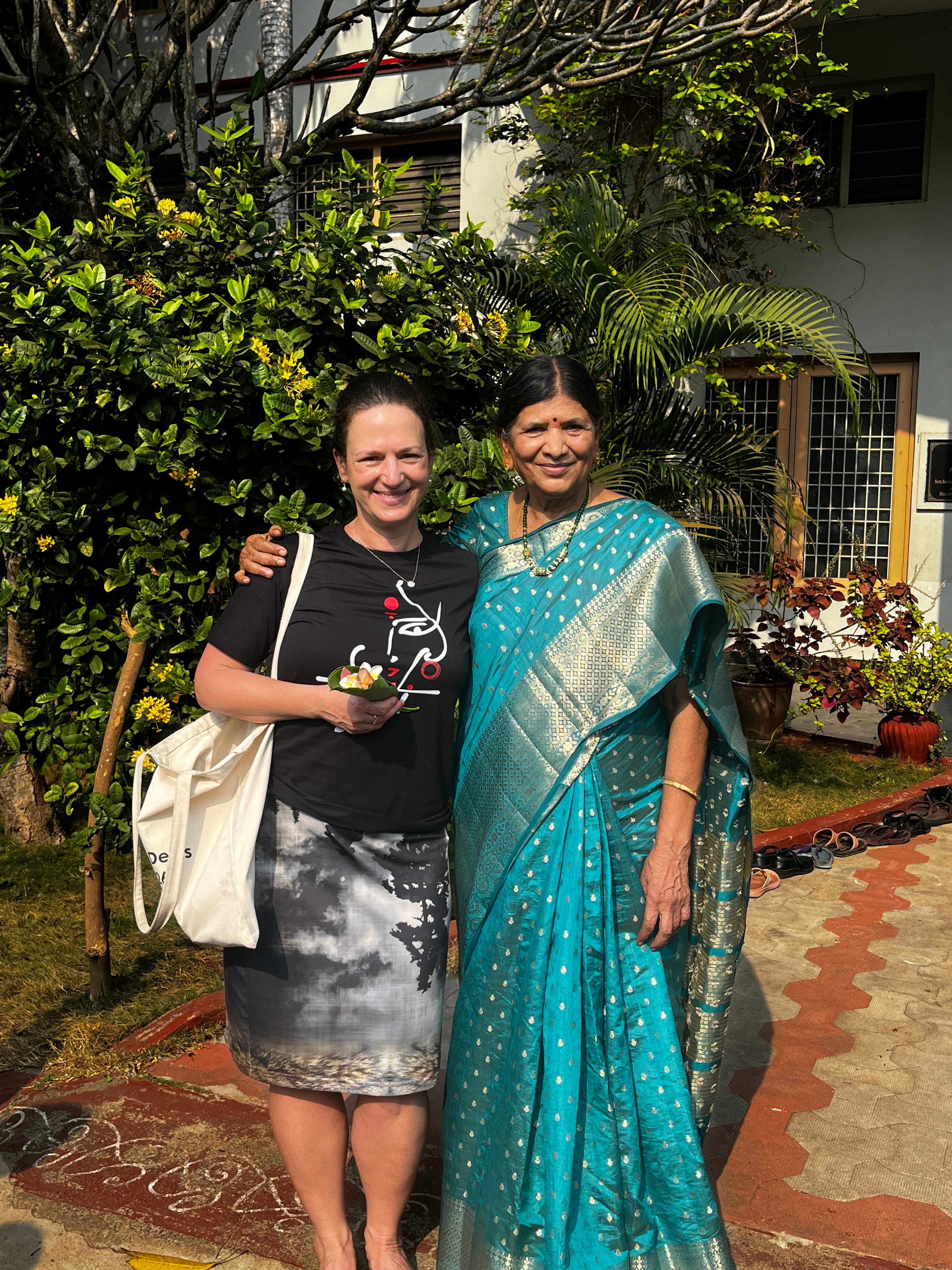
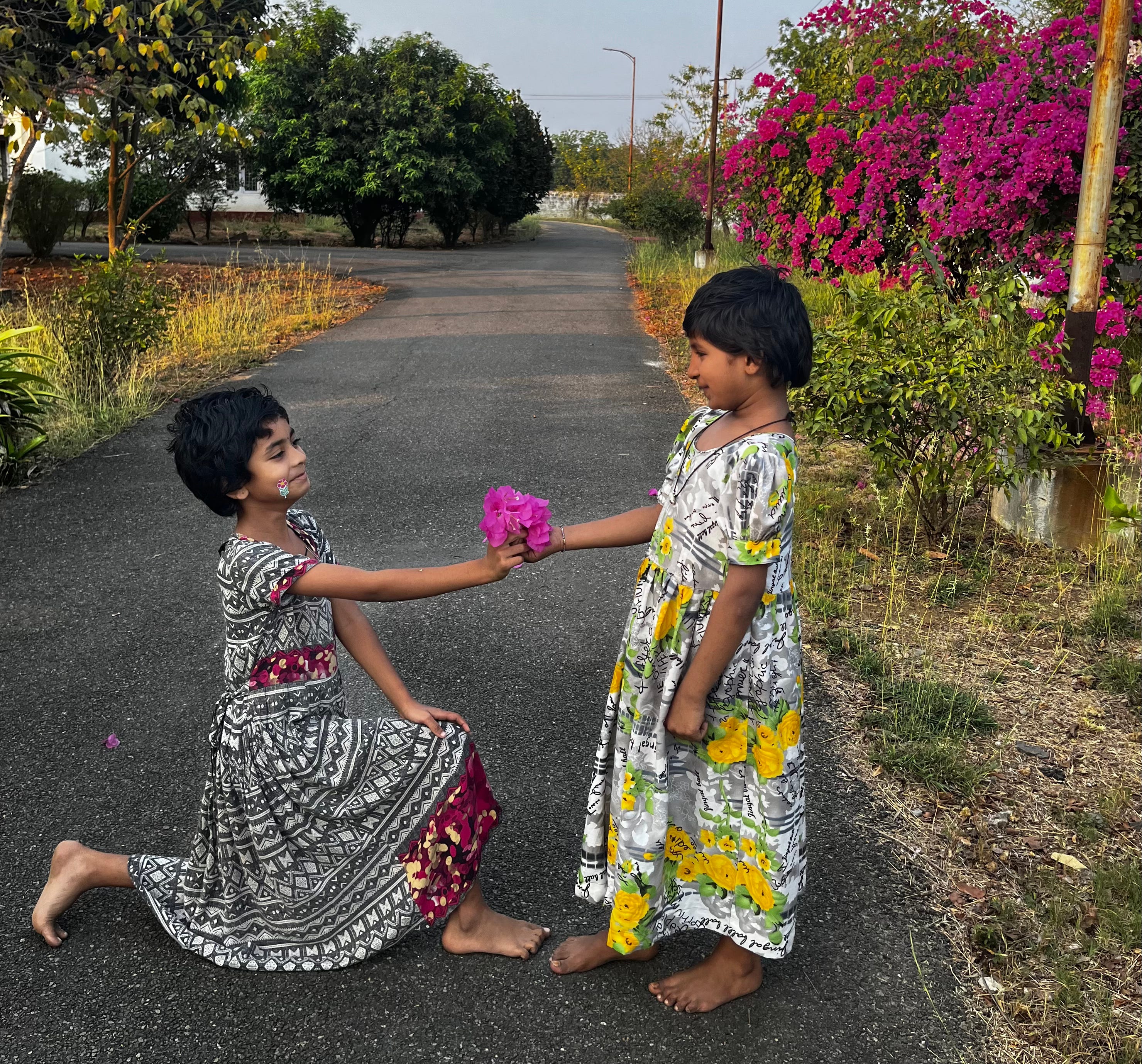
I had a tote bag with a strap that kept slipping off my shoulder. And again and again, without announcement, I would feel a small hand (often the littlest 5-7 year olds) move up my arm and gently lift the strap back into place—like someone quietly insisting: I see you. I want to help you. Then they would take my hand and quickly pull me along on the trail to pick some fruit off a nearby tree or pluck even more flowers to add to my hair or the overflowing bouquet I was already carrying. And after I received the gift, they would immediately resume holding my hand with such a delighted smile.
That was it. That was the whole thing. Not a big speech (some of the youngest didn’t speak English, and I don’t speak Telugu or Hindi). Not a bonding exercise. Not a “sisterhood” slogan. Just a sweet accompaniment. My body recognized it instantly as care. And I felt, in the simplest way, what had been missing: the sense that someone was tracking my comfort, my presence. I mattered.

What does this have to do with Pink Zones?
There’s a kind of wisdom culture that tells us, correctly, that no one can do our work for us. No friend can metabolize our grief. No teacher can hand us our authority. No community can swoop in and save us from the difficult task of becoming ourselves, the lifelong work of individuation.
But we often absorb that truth in a distorted form. It turns into rugged individualism: If I’m mature, I shouldn’t need anyone. If I’m strong, I should be fine alone. So, we swing between two extremes—enmeshed dependence on one side, disconnection on the other.
Pink Zones are built on a third way.
We can’t do each other’s learning, of course. But we can accompany. We can offer steadiness without taking over. We can make the hill feel less steep, simply by staying close enough that someone doesn’t have to face the whole thing alone.
Which is why I keep returning to the image of holding hands.
Holding hands is not only a metaphor.
In a now-classic fMRI study, neuroscientist James Coan ( Jim coan ) and colleagues found that when participants anticipated a threat, simply holding the hand of a trusted partner reduced activity in brain regions associated with threat responding. This means that the same stressor can literally register as less intense when we are not facing it alone.
Coan, J. A., Schaefer, H. S., & Davidson, R. J. (2006). Lending a Hand: Social Regulation of the Neural Response to Threat: Social Regulation of the Neural Response to Threat. Psychological Science, 17(12), 1032-1039.
If you care about immune resilience as you age, this matters too.
When our nervous systems are in threat—especially social threat—our immune systems don’t stay neutral.
Research suggests that adverse social experiences (isolation, perceived social threat) can raise inflammatory activity while dampening antiviral defenses, while supportive social connection may do the opposite—lower inflammation and bolster antiviral responses.
In other words, your immune system isn’t only asking, “Are there germs?” It’s also asking, “Is the social world safe?”
If the body reads the environment as unsafe, it may shift into an inflammatory “prepare for wounding” posture. In that shift, antiviral protection can be dialed down. Acutely, that trade-off could be adaptive. If this is done chronically, that loss of protection becomes costly.
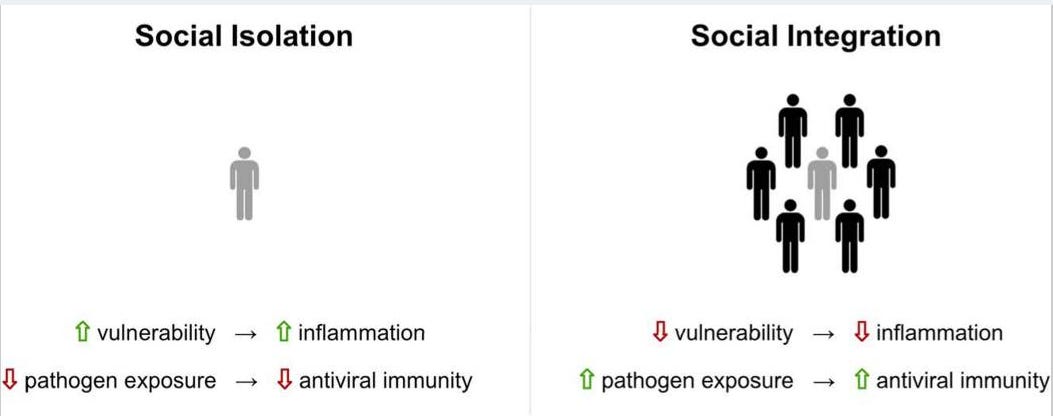
Leschak, C. J., & Eisenberger, N. I. (2019). Two Distinct Immune Pathways Linking Social Relationships With Health: Inflammatory and Antiviral Processes. Psychosomatic Medicine, Oct;81(8):711-719.
This is why we might see that chronic social unsafety—chronic self-editing, chronic scanning, chronic bracing—can become a detrimental health condition.
If we absorb the messages in our culture that our bodies are problematic as we age, that our very evidence of having crinkled our faces to smile (wrinkles!) needs to be edited out, that we will inevitably be less attractive, it isn’t only taxing on the level of our mind or heart; It can negatively impact our deeper physical health.
And there’s a gendered layer here that has been noted for a while: autoimmune disease disproportionately affects women (often cited as roughly 80%). The causes are complex—hormones, genetics, immune regulation, and life-stage shifts. If women are also the ones more likely to carry a chronic caregiving load and relational strain, and if we are taught that we constantly need to scan for signs we don’t fit or we need to fix ourselves in order to do so, what do these factors do to our immunity and ability to put inflammation in check?
Which brings me back to Pink Zones.
The Pink Zones are the conditions that help women thrive as they age.
Not the aesthetic of togetherness captured in a photo, not “girls’ trip energy”. True connection comes from real relational health. The kind of community where you don’t have to self-censor to stay included—where the relational floor is steady enough that your nervous system can relax.
In a Pink Zone, the bag strap gets lifted back onto your shoulder—not because you’re incapable, but because you’re human. Because we all need an assist sometimes.
And maybe that’s the simplest definition I can offer:
Community is not meant to do your life for you. It’s meant to help you keep your humanity intact and “have your back” while you do the work that is yours.
So here’s my practical question: how do we help one another feel like we belong?
How do we create a Pink Zone in ordinary moments, with ordinary gestures?
Here is what I am thinking so far…
Sometimes it looks like a deep conversation and listening.
Sometimes it’s answering a question that got ignored.
Sometimes it looks like turning toward a person at the edge and making room at a table or saving them a seat.
Sometimes it is smiling at someone even though they are a stranger.
And sometimes it looks like the smallest, simplest, kindest thing: offering a hand.
I returned to an exercise class I had tried for the first time, and the teacher came up to me and said I had a smile on my face during the entire first class. I think this is something I do unconsciously to lighten the energetic space I occupy.
Loved this. "Community is not meant to do your life for you. It’s meant to help you keep your humanity intact and “have your back” while you do the work that is yours." And the notion of accompanying rather than doing the work of someone else's life. I was in a women's circle yesterday where we acknowledged the hurt other women have done to us -- the gap between what accompanying can be and the reality of 'mean girls' who are sometimes our biological mothers or sisters... too. But when accompanying works the difference it makes! The words I use as a herbalist are companion and bridge -- walking the path with someone, helping to bridge betweeen the terrain of their bodies and that of the plants who will help them do the healing work. And you are so right that just a simple smile can make a difference -- I had an experience in Paris a couple of years ago -- we'd got off the train and were madly searching for the taxi we'd booked outside Montparnasse station. I tend to go around the world smiling at people and suddenly a woman crossed the road and put her hand on my arm and said 'thank you' -- I looked blank and she said she'd been watching me smile at people and that it made the world more beautiful. In that moment we'd both given a small act.